
Studio apartment
See how summer heat, everyday cooking, and ventilation choices shape the air and comfort of a compact lived-in home.
Monitoring report
24-hour monitoring window · 288 five-minute datapoints per measurement
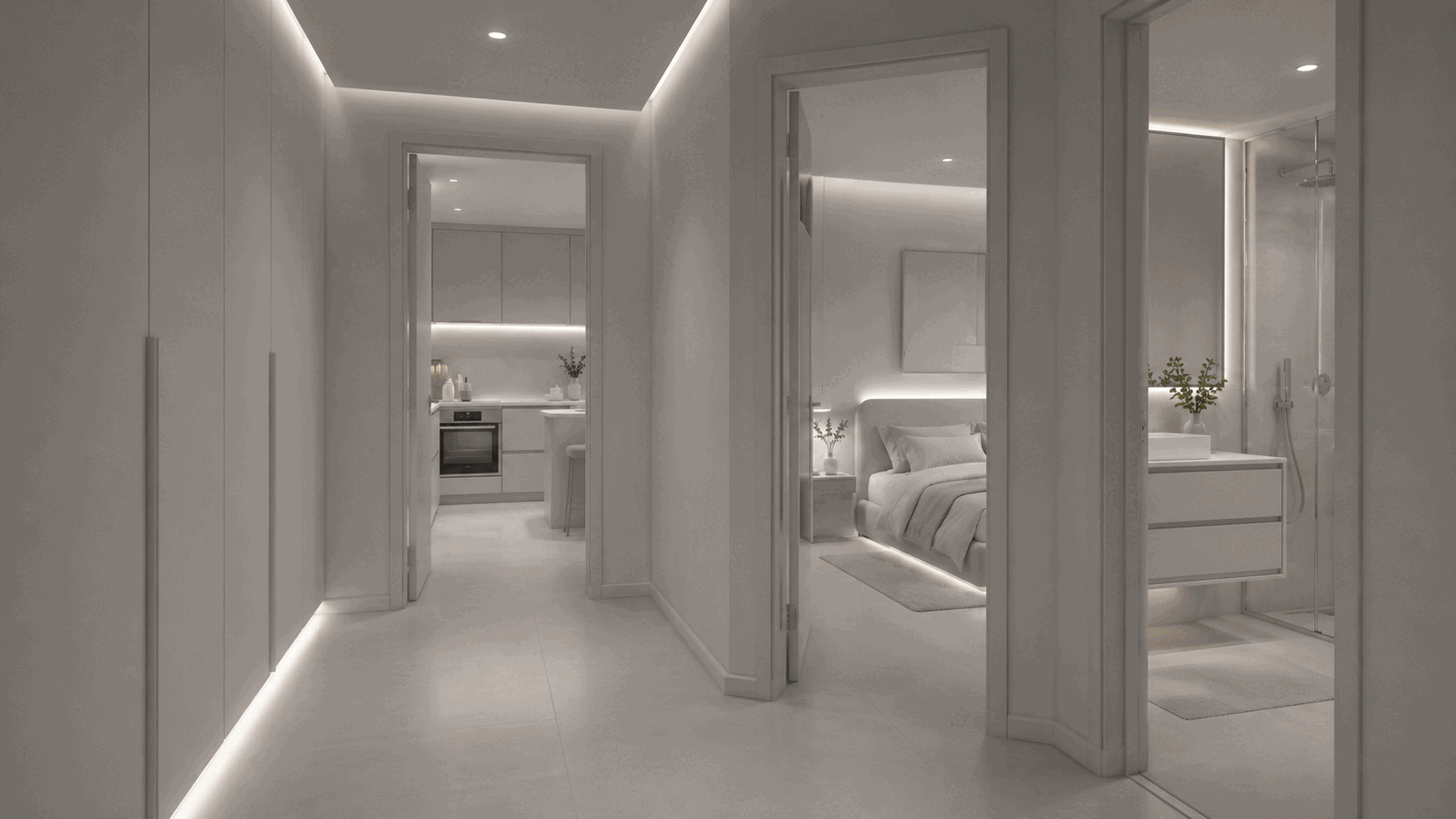
This sample follows a roughly 50-square-meter studio apartment over 24 hours of hot summer weather, from 17:15 on the first day to 17:15 the following day. Two people lived and slept in the space, with the bathroom exhaust fan on, all windows closed, interior doors open, and an electric stove used for cooking several times during the day.
Description
CO2 builds up when occupants exhale faster than the ventilation system introduces fresh air. This can lead to cognitive fatigue and drowsiness. Although the bathroom exhaust fan was on, the sealed, mostly airtight windows and entrance door meant it could not provide effective ventilation.
What happened
CO2 rose from about 488 ppm at 17:15, crossed 1000 ppm at 19:05, and then remained above 1000 ppm for almost 19 hours. It peaked at 1691 ppm at 23:20. Across the 24-hour window, the average was 1370 ppm and 89.9% of five-minute datapoints exceeded 1000 ppm. CO2 moved strongly with radon (r = 0.77) and moderately with humidity (r = 0.58), consistent with several indoor constituents accumulating under restricted air exchange; correlation alone does not identify a single cause.
Recommendations
- Open windows on two sides of the apartment now, where safe, to create cross-ventilation; if heat, noise, security, or outdoor pollution makes that impractical, install a balanced heat- or energy-recovery ventilator sized for two sleeping occupants.
- Whenever the bathroom or cooking exhaust runs, open a dedicated trickle vent or window to provide makeup air; open interior doors alone do not bring outdoor air into the sealed apartment.
- Set an early operational CO2 ventilation alert—not a universal health limit—around 800 ppm and ventilate before the trend reaches 1000 ppm, especially before sleep and while cooking; a recirculating air conditioner or portable particle filter will not remove CO2.
- Repeat a full occupied night after the change. If CO2 still remains above 1000 ppm, have a ventilation professional measure supply and extract airflow and rebalance the system.
Data
- Average CO2
- 1,370 ppm
- Peak CO2
- 1,691 ppm
- Datapoints above 1000 ppm
- 89.9 %
Description
Radon is a naturally occurring radioactive gas. It accumulates in the soil beneath a building and climbs through the path of least resistance. Even with a solid, seamless foundation slab, the microscopic gaps around utility pipes act like chimneys that pull this gas into your space.
What happened
Radon began at 23 Bq/m³, briefly fell to 8 Bq/m³ near 17:40, and then rose overnight to a peak of 135 Bq/m³ at 04:10. The 24-hour average was 65.7 Bq/m³, with 11.5% of five-minute datapoints above 100 Bq/m³. Its positive association with CO2 (r = 0.77) and humidity (r = 0.62) is consistent with a shared ventilation or pressure pattern, but does not establish causation.
Recommendations
- Begin a long-term radon measurement of at least 30 days in the lowest regularly occupied area, especially in the heating season; the one-day peak of 135 Bq/m³ is a prompt to confirm exposure, not a reliable annual average.
- Provide balanced makeup air whenever the bathroom exhaust runs, because sustained depressurization can draw soil gas through gaps; do not use an additional exhaust fan as a stand-alone radon fix.
- Inspect and seal accessible slab cracks, floor-wall joints, drains, and utility penetrations now, while recognizing that sealing alone does not reliably control radon.
- If the long-term average reaches or exceeds the WHO reference of 100 Bq/m³, engage a qualified radon professional to design active sub-slab depressurization or another suitable system and retest after it is commissioned.
Data
- Average radon
- 65.7 Bq/m³
- Peak radon
- 135 Bq/m³
- Datapoints above 100 Bq/m³
- 11.5 %
Description
Fine airborne particles accumulate from daily operations, cooking, cleaning agents, and incoming outdoor air. Left unmanaged, these microscopic particulates degrade indoor air quality and can trigger respiratory irritation or long-term health issues.
What happened
PM2.5 reached its highest five-minute mean of 10.3 µg/m³ at 17:30, averaged 3.94 µg/m³, and declined to a minimum of 2.56 µg/m³ by 14:15 the next day. No five-minute datapoint exceeded 15 µg/m³. The inverse correlation with CO2 (r = −0.59) reflects their opposing trends over this particular day and is not evidence that one reduced the other.
Recommendations
- Turn the externally vented range hood on before cooking, use the back burners and lids where practical, and keep it running until PM2.5 returns to the pre-cooking level.
- Keep smoking, candles, incense, and aerosol cleaning out of the occupied apartment; these source-control measures are more effective than trying to filter particles after they spread.
- Use a non-ozone-producing portable HEPA cleaner with a smoke CADR sized for the room when windows must remain closed, and clean or replace its filter on schedule.
- Check outdoor PM2.5 before airing the apartment: use cross-ventilation when outdoor air is cleaner, but close windows and rely on filtration during smoke or high-pollution episodes.
Data
- Average PM2.5
- 3.9 µg/m³
- Peak PM2.5
- 10.3 µg/m³
- Datapoints above 15 µg/m³
- 0 %
Description
Thermal comfort and moisture levels fluctuate constantly. Unregulated humidity and temperature swings compromise indoor comfort, drive up energy costs, and create breeding grounds for mold and structural damage.
What happened
Temperature ranged from 21.2°C to 25.5°C and averaged 23.6°C. Relative humidity ranged from 41.6% to 57.8% and averaged 49.2%. Every five-minute datapoint remained within the selected 20–26°C and 40–60% comfort bands. Temperature and humidity moved together strongly (r = 0.93), consistent with the daily heat and moisture cycle observed in the apartment.
Recommendations
- Keep daytime solar gains down with exterior shading or closed blinds, and flush the apartment with cooler outdoor air during the evening or early morning when outdoor conditions permit.
- Keep relative humidity ideally between 30% and 50% and always below 60%; run bathroom and cooking extraction with makeup air, and use a dehumidifier if humidity remains above 60%.
- Use fans or efficient cooling for comfort, but do not close the fresh-air path to lower temperature; balanced heat- or energy-recovery ventilation can preserve both comfort and air exchange.
- Set alerts at the chosen upper comfort limits—26°C and 60% RH—and inspect for condensation, leaks, or blocked condensate drains immediately if either limit persists.
Data
- Average temperature
- 23.6 °C
- Lowest temperature
- 21.2 °C
- Highest temperature
- 25.5 °C
- Average relative humidity
- 49.2 %
- Lowest relative humidity
- 41.6 %
- Highest relative humidity
- 57.8 %
- Datapoints in both comfort bands
- 100 %
- baseworks.tech ecosystem software version
- 1.0.133
- CO2 sensor
Sensor: SCD40
Device: Apollo MSR-2
Software version: 26.7.14.1
- Radon sensor
Sensor: Aranet Radon Plus
- Fine particles sensor
Sensor: SEN55
Device: Apollo AIR-1
Software version: 26.7.14.1
- Temperature and humidity sensor
Sensor: Aranet Radon Plus