
Movie premiere - full room
See how a medium-sized cinema room handles near-capacity attendance, with real readings showing the resulting ventilation and cooling load.
Monitoring report
165-minute monitoring window · 33 five-minute datapoints per measurement
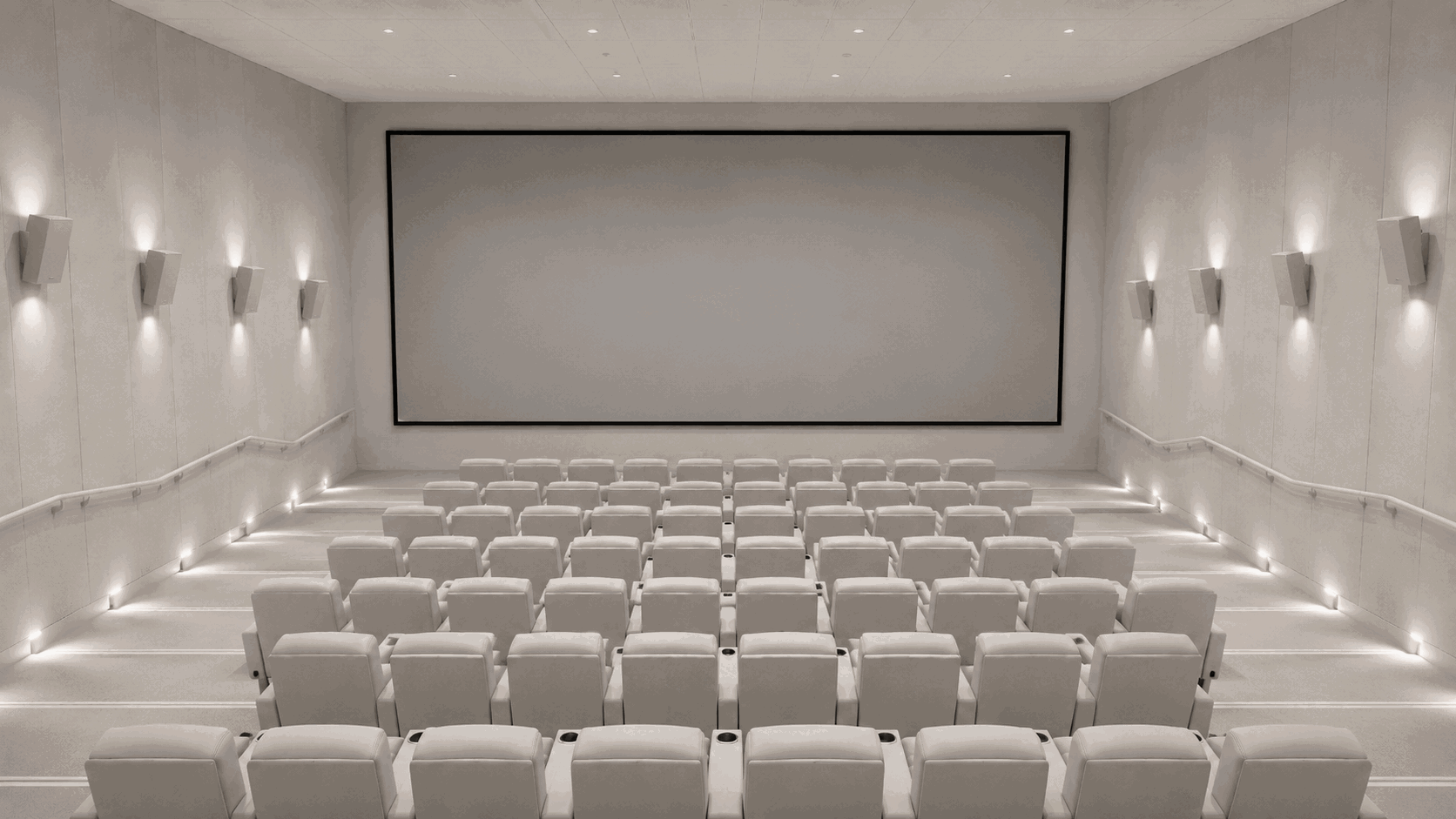
This sample follows a medium-sized cinema room of roughly 250 square metres during a 165-minute observation at approximately 90% attendance. The data captures how near-capacity occupancy affected ventilation, particles, radon, temperature, and humidity during the screening period.
Description
CO2 builds up when occupants exhale faster than the ventilation system introduces fresh air. This can lead to cognitive fatigue and drowsiness.
What happened
CO2 was already 1,054 ppm at the start, averaged 1,246 ppm, and peaked at 1,312 ppm at 18:20. Every five-minute datapoint was above 1000 ppm, showing that outdoor-air delivery did not keep pace with the roughly 90% attendance. CO2 and humidity moved together strongly (r = 0.84), which is consistent with a shared occupancy and ventilation load but does not establish a single cause.
Recommendations
- Increase outdoor-air delivery before admitting the audience and keep it boosted throughout the screening; verify that outdoor-air dampers are open and the system is not operating in recirculation-only mode.
- Use 800 ppm as an early operational ventilation alert—not a universal health limit—and temporarily cap attendance if CO2 remains above 1000 ppm after the system reaches full airflow.
- Have an HVAC professional measure and rebalance supply, extract, and outdoor airflow for near-capacity operation; portable particle filters do not remove CO2.
- Continue the higher ventilation rate for at least 30 minutes after the screening and repeat the same attendance test to confirm a lower baseline and peak.
Data
- Average CO2
- 1,246 ppm
- Peak CO2
- 1,312 ppm
- Datapoints above 1000 ppm
- 100 %
Description
Radon is a naturally occurring radioactive gas. It accumulates in the soil beneath a building and climbs through the path of least resistance. Even with a solid, seamless foundation slab, the microscopic gaps around utility pipes act like chimneys that pull this gas into your space.
What happened
Radon stayed low during the observation, averaging 9.7 Bq/m³ and peaking at 17.7 Bq/m³, with no five-minute datapoint above 100 Bq/m³. This short event sample is reassuring for the screening window but cannot establish the building’s long-term average.
Recommendations
- Keep a radon monitor in the lowest regularly occupied, ground-contact zone for at least 30 days, especially during the heating season.
- Keep supply and extract air balanced so higher cinema ventilation does not depressurize adjacent ground-contact spaces.
- Inspect accessible slab joints and service penetrations during routine maintenance; if a long-term average reaches 100 Bq/m³, engage a qualified radon professional and retest after mitigation.
Data
- Average radon
- 9.7 Bq/m³
- Peak radon
- 17.7 Bq/m³
- Datapoints above 100 Bq/m³
- 0 %
Description
Fine airborne particles accumulate from daily operations, cooking, cleaning agents, and incoming outdoor air. Left unmanaged, these microscopic particulates degrade indoor air quality and can trigger respiratory irritation or long-term health issues.
What happened
PM2.5 remained low overall, averaging 4.0 µg/m³. A short rise peaked at 9.5 µg/m³ at 18:15 and returned to 3.3 µg/m³ by the end; no five-minute datapoint exceeded 15 µg/m³. The brief pattern points to a transient source rather than sustained particle buildup.
Recommendations
- Trace the 18:15 spike against auditorium operations—door openings, audience movement, HVAC mode changes, cleaning, or emissions migrating from the concession area—and correct any source that recurs at the same point in a screening.
- Inspect the auditorium air-handler filters, seals, and bypass paths; use MERV 13 filtration (approximately ISO ePM1 50%) or the highest rating the system supports without reducing the outdoor airflow needed for CO2 control.
- Balance concession-area extraction and lobby airflow so cooking aerosols do not migrate into the auditorium, and verify airflow direction while food service and audience entry are both active.
- If screening-period spikes recur after source control, use a correctly sized, non-ozone-producing HEPA unit as supplemental filtration, positioned so it does not obstruct exits or create disruptive noise.
Data
- Average PM2.5
- 4 µg/m³
- Peak PM2.5
- 9.5 µg/m³
- Datapoints above 15 µg/m³
- 0 %
Description
Thermal comfort and moisture levels fluctuate constantly. Unregulated humidity and temperature swings compromise indoor comfort, drive up energy costs, and create breeding grounds for mold and structural damage.
What happened
Temperature stayed warm for the full observation, averaging 27.4°C and ranging from 26.7°C to 27.9°C; every five-minute datapoint was above 26°C. Relative humidity averaged 43.0% and remained between 38.9% and 44.6%. The cooling load, rather than humidity, was the clear comfort issue.
Recommendations
- Pre-cool the room before admission and bring the cooling system to occupied mode before the audience enters.
- Check diffuser coverage, return-air paths, and cooling capacity for roughly 90% attendance while keeping outdoor-air ventilation active.
- Use air movement for comfort and keep humidity in its current range; do not reduce fresh-air delivery simply to lower temperature.
- Repeat temperature, humidity, and CO2 measurements together after rebalancing to confirm that both comfort and ventilation improve.
Data
- Average temperature
- 27.4 °C
- Lowest temperature
- 26.7 °C
- Highest temperature
- 27.9 °C
- Datapoints above 26°C
- 100 %
- Average relative humidity
- 43 %
- Lowest relative humidity
- 38.9 %
- Highest relative humidity
- 44.6 %
- baseworks.tech ecosystem software version
- 1.0.133
- CO2 sensor
Sensor: SCD40
Device: Apollo MSR-2
Software version: 26.7.14.1
- Radon sensor
Sensor: Aranet Radon Plus
- Fine particles sensor
Sensor: SEN55
Device: Apollo AIR-1
Software version: 26.7.14.1
- Temperature and humidity sensor
Sensor: Aranet Radon Plus