
Movie night at the cinema
See how a well-ventilated room responds during an 115-minute movie at 10% attendance, with real readings before, during, and after the screening.
Monitoring report
115-minute monitoring window · Five-minute readings from the movie-night observation
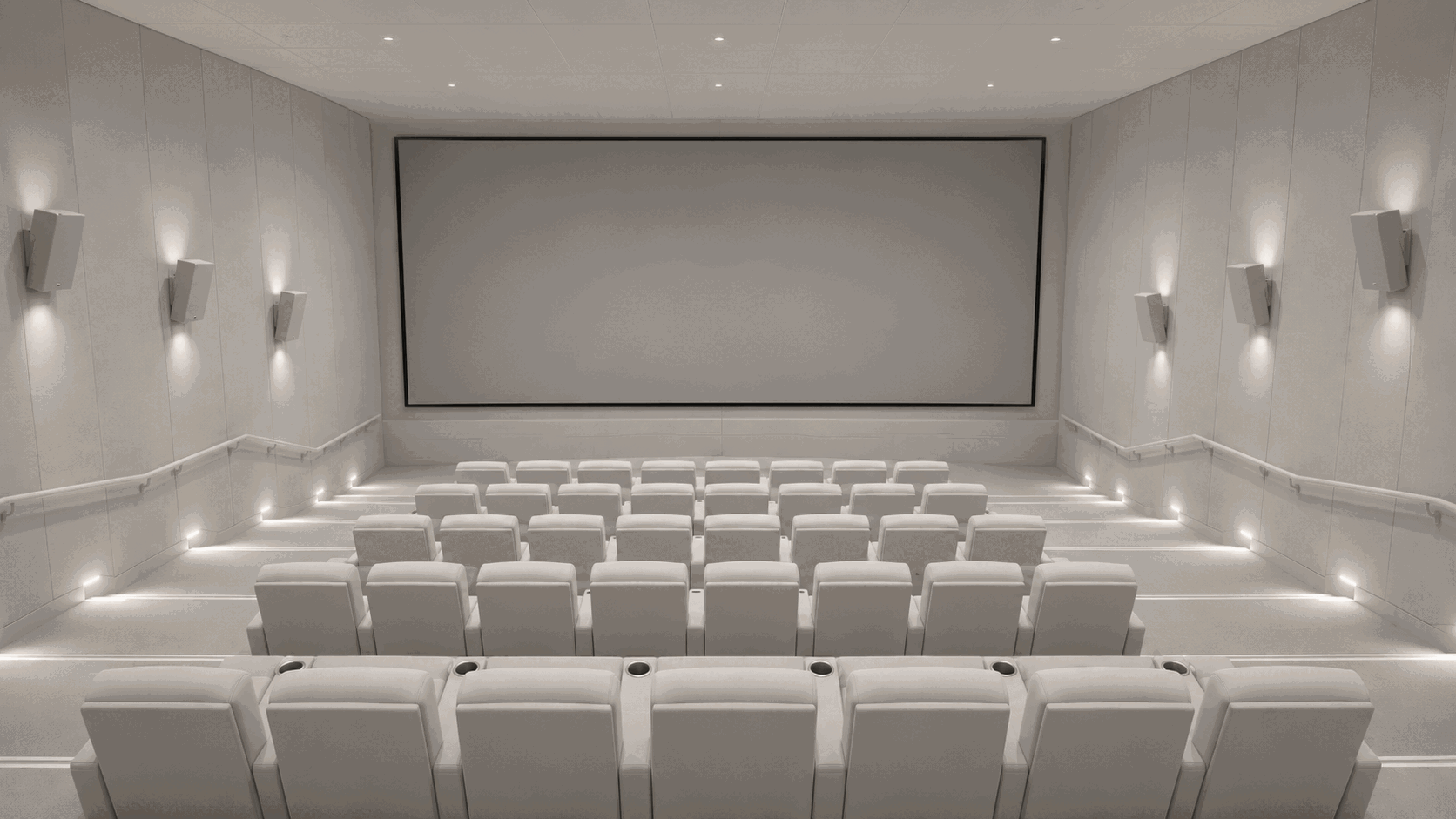
This sample follows a well-ventilated, roughly 150-square-meter room with all doors closed. The room operated at 10% attendance during an 115-minute movie, with measurements recorded throughout the screening.
Description
CO2 builds up when occupants exhale faster than the ventilation system introduces fresh air. This can lead to cognitive fatigue and drowsiness.
What happened
CO2 rose gradually from 425 ppm to 646 ppm across the observation period, remaining comfortably below the 1000 ppm reference level at 10% attendance. This shows that outdoor-air delivery kept pace with this low-occupancy screening, but it does not establish performance at higher attendance.
Recommendations
- Preserve the current outdoor-air settings for similarly attended events and start ventilation at least 30 minutes before guests arrive; record the empty-room CO2 baseline before each event.
- Set an early operational ventilation alert—not a universal health limit—around 800 ppm. If CO2 rises continuously toward it, increase outdoor-air delivery, open a safe fresh-air path, or pause entry until the trend stabilizes.
- Continue ventilation for at least 30 minutes after the audience leaves, repeat measurements whenever attendance increases, and investigate any future occupied reading more than roughly 10% above the established event baseline.
Data
- Average CO2
- 544 ppm
- Peak CO2
- 646 ppm
- Number of datapoints above 1000 ppm
- 0 %
Description
Radon is a naturally occurring radioactive gas. It accumulates in the soil beneath a building and climbs through the path of least resistance. Even with a solid, seamless foundation slab, the microscopic gaps around utility pipes act like chimneys that pull this gas into your space.
What happened
Readings fell from 26 Bq/m³ to a low, stable range of roughly 1–3 Bq/m³ during the observation period.
Recommendations
- Keep a radon monitor in the lowest regularly occupied, ground-contact zone in the room for at least 30 days, especially in the heating season; this short low reading cannot establish the annual building average.
- Inspect accessible slab joints, service penetrations, drains, and sump covers now and repair gaps.
- Keep supply and extract air balanced so the cinema does not depressurize adjacent ground-contact spaces during screenings.
- If the long-term average reaches or exceeds the WHO reference of 100 Bq/m³, engage a qualified radon professional to select a building-specific mitigation system and verify the result with a post-mitigation test.
Data
- Average radon
- 5 Bq/m³
- Peak radon
- 26 Bq/m³
Description
Fine airborne particles accumulate from daily operations, cooking, cleaning agents, and incoming outdoor air. Left unmanaged, these microscopic particulates degrade indoor air quality and can trigger respiratory irritation or long-term health issues.
What happened
PM2.5 stayed low throughout the screening, declining from 5.91 µg/m³ to approximately 4.62 µg/m³ with no smoking-related spike.
Recommendations
- Keep the no-smoking rule and also prohibit candles, incense, and other combustion sources during events.
- If popcorn or other food is prepared, capture emissions at an externally vented hood before they enter the screening room and keep extraction running until readings recover.
- Use MERV 13 filtration (approximately ISO ePM1 50%), or the highest rating the HVAC system can support, and add a non-ozone-producing portable HEPA cleaner sized by smoke CADR when outdoor smoke or food service raises particle risk.
- Check outdoor PM2.5 before increasing unfiltered outdoor air, replace loaded filters promptly, and compare readings before, during, and 30 minutes after each event.
Data
- Average PM2.5
- 5 µg/m³
- Peak PM2.5
- 6 µg/m³
Description
Thermal comfort and moisture levels fluctuate constantly. Unregulated humidity and temperature swings compromise indoor comfort, drive up energy costs, and create breeding grounds for mold and structural damage.
What happened
Temperature rose gradually from 25.4°C to 27°C even at 10% attendance, while relative humidity stayed in a narrow 51.6%–53.1% range. The temperature trend indicates that cooling performance should be checked before hosting a more highly attended screening.
Recommendations
- Pre-cool the room before guests arrive so the screening starts near the preferred comfort temperature, then increase total airflow or use ceiling fans rather than reducing outdoor-air ventilation as the room warms.
- Because temperature reached 27°C at only 10% attendance, check diffuser coverage, return-air paths, and available cooling capacity now, then adjust the cooling schedule before the next movie screening.
- Keep relative humidity ideally between 30% and 50% and always below 60%; use the HVAC system or dedicated dehumidification if it stays above 60%, and inspect any condensation immediately.
- Measure temperature, humidity, and CO2 together during every higher-attendance screening so cooling changes do not compromise fresh-air delivery and the system can be verified under the actual occupancy load.
Data
- Average temperature
- 26.1 °C
- Highest temperature
- 27 °C
- Average relative humidity
- 53 %
- baseworks.tech ecosystem software version
- 1.0.133
- CO2 sensor
Sensor: SCD40
Device: Apollo MSR-2
Software version: 26.7.14.1
- Radon sensor
Sensor: Aranet Radon Plus
- Fine particles sensor
Sensor: SEN55
Device: Apollo AIR-1
Software version: 26.7.14.1
- Temperature and humidity sensor
Sensor: Aranet Radon Plus